
Online Degree in India: 10 Things Every Student Should Know in 2026
Choosing an online degree in India is no longer just about studying from home. In 2026, online education has become a practical way for students and working professionals to earn a recognised qualification while building skills for a changing job market. With better learning platforms, live sessions, digital resources, and faculty support, online education in India offers more flexibility than traditional classroom learning.
But flexibility comes with responsibility. Students need to understand how online degree courses in India work, what makes a programme credible, and which skills they should build alongside their degree. From managing your schedule to using AI responsibly, your experience depends on much more than simply attending online classes for students.
Marwadi University Online is NAAC A+ accredited, has NBA Tier-1 programs, holds a 353 QS Asia rank, a Top 115-150 NIRF rank, and is awarded Centre of Excellence by the Government of Gujarat.
Before choosing a programme, it is important to look beyond convenience and understand the real online degree benefits. Whether you are a fresh graduate, a working professional, or someone looking to continue your education, these 10 things can help you make smarter decisions and get more value from your degree.
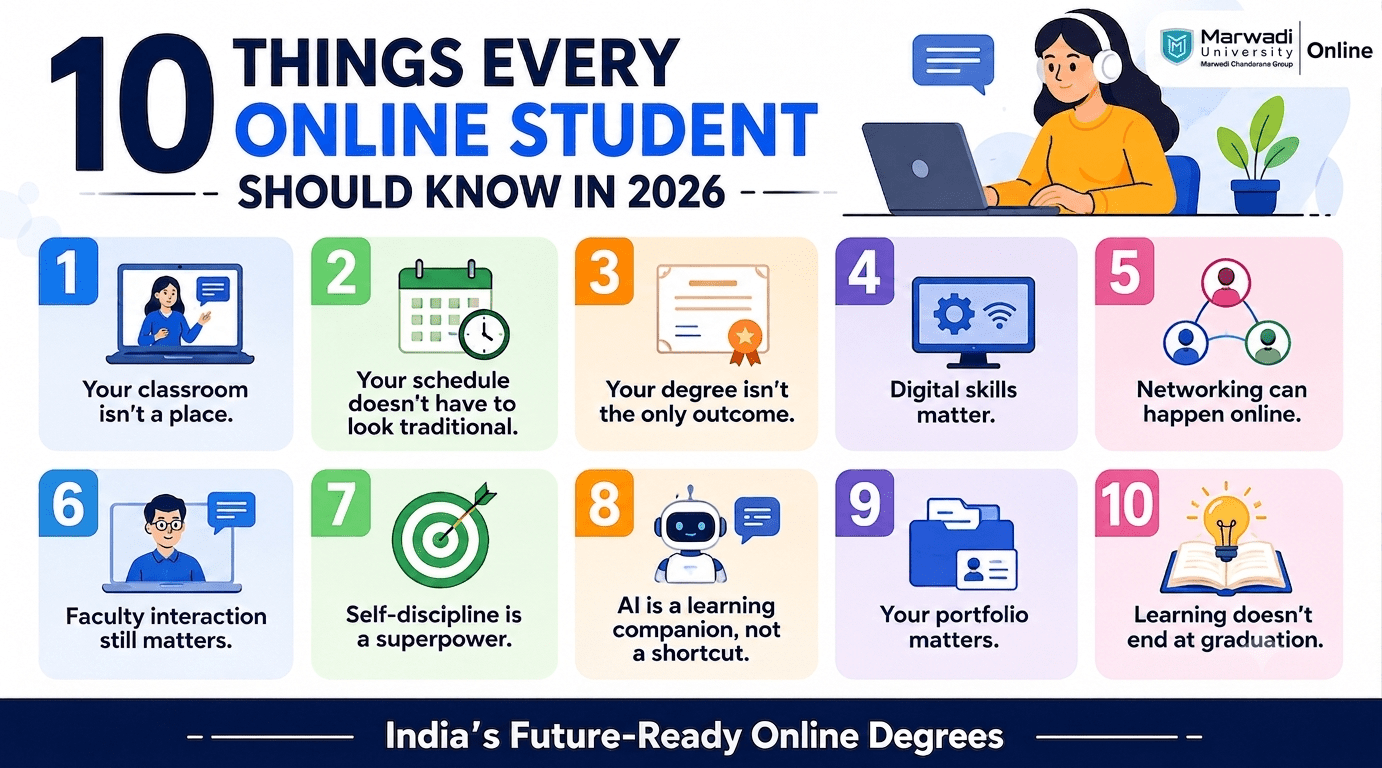
1. Your classroom isn’t a place
One of the biggest changes brought by online learning in India is that your classroom can be almost anywhere. You may attend a live lecture from home, watch a recorded session while travelling, or study course material at a time that suits you.
What this means for students:
- Learn from almost anywhere.
- Access digital study material.
- Revisit recorded lectures.
- Study using a laptop, tablet, or smartphone.
Understanding how online learning works helps students use this flexibility effectively instead of treating online education as simply watching videos.
2. Your schedule doesn’t have to look traditional
A major advantage of online education in India is flexibility. Students do not always have to follow the same daily routine as traditional campus learners. Depending on the programme, they may combine live classes, recorded lectures, assignments, discussions, and self-study.
You can:
- Create a personalised study routine.
- Learn around work or other commitments.
- Use recorded content for revision.
- Set weekly academic goals.
This is one of the key benefits of online education, especially for students who need greater control over their time.
3. Your degree isn’t the only outcome
An online degree in India should give you more than a certificate. The learning experience can help you develop communication, research, problem-solving, collaboration, and time-management skills.
Focus on developing:
- Communication skills
- Critical thinking
- Problem-solving
- Research abilities
- Professional confidence
These additional skills can make your qualification more valuable in the workplace. The best online degree benefits come when students actively apply what they learn instead of studying only for examinations.
4. Digital skills matter
Studying through technology naturally exposes students to digital tools and workflows. From learning management systems to online presentations and collaborative platforms, technology becomes part of the learning experience.
Build skills such as:
- Digital communication
- Online collaboration
- Presentation tools
- Data handling
- Basic AI literacy
As businesses become increasingly digital, these skills can complement your academic qualification. This makes online degree courses in India particularly relevant for students preparing for technology-driven workplaces.
5. Networking can happen online
Think networking is only possible on a college campus? Not anymore. Online learning in India has created new ways for students to connect with classmates, faculty members, industry professionals, and alumni.
Try:
- Participating in online discussions.
- Joining virtual events.
- Collaborating on projects.
- Connecting professionally on LinkedIn.
- Attending webinars and workshops.
Building genuine professional relationships can become one of the most useful online degree benefits, particularly when students actively participate instead of remaining passive learners.
6. Faculty interaction still matters
Online learning does not mean learning alone. Quality programmes provide opportunities to interact with faculty through live sessions, discussions, doubt-solving, assignments, and other academic support.
Look for:
- Experienced faculty.
- Interactive live sessions.
- Doubt-resolution support.
- Academic guidance.
- Regular feedback.
Before enrolling, understand how faculty interaction works. When evaluating an online degree in India, don’t look only at fees and flexibility. The quality of teaching and student support can significantly shape your learning experience.
7. Self-discipline is a superpower
Flexibility sounds great, but it can also become a challenge. Without a fixed classroom routine, students need to take greater responsibility for attending classes, completing assignments, revising lessons, and preparing for exams.
Build simple habits:
- Follow a weekly timetable.
- Set reminders for deadlines.
- Study in focused sessions.
- Avoid last-minute preparation.
- Track your academic progress.
Successful online learning in India requires consistency. Technology can provide access to education, but your habits determine how much you gain from it.
8. AI is a learning companion, not a shortcut
AI is changing education, but students should use it responsibly. It can help explain difficult concepts, generate ideas, summarise information, or support brainstorming. However, simply copying AI-generated answers can weaken your understanding and academic skills.
Use AI to:
- Understand complex topics.
- Brainstorm ideas.
- Practise questions.
- Improve drafts.
- Explore different perspectives.
The goal is not to let AI do your learning. Instead, use it as a learning companion while developing your own judgement, creativity, and critical thinking.
9. Your portfolio matters
Your degree tells employers what you studied. Your portfolio can show what you can actually do. Students should therefore build practical evidence of their skills while completing their programme.
Create:
- Projects
- Case studies
- Presentations
- Writing samples
- Certifications
- Relevant work samples
These can strengthen your professional profile and demonstrate practical abilities. For students pursuing online degree courses in India, a strong portfolio can complement academic achievements when applying for internships and jobs.
10. Learning doesn’t end at graduation
The future of online education is closely connected to lifelong learning. Industries change quickly, and skills that are valuable today may evolve tomorrow. Completing a degree should therefore be viewed as one stage of your learning journey.
Keep learning through:
- Short-term courses
- Professional certifications
- Industry webinars
- Skill-based projects
- New digital tools
The real value of an online degree in India grows when you continue upgrading your knowledge after graduation. Staying curious can help you adapt to changing career opportunities and workplace expectations.
Final Thoughts
An online degree in India can offer much more than flexible study. It can help you build academic knowledge, digital skills, professional connections, practical experience, and the confidence to keep learning. But your results depend on how actively you use the opportunities available to you.
Before choosing a programme, check its recognition, curriculum, faculty support, learning format, assessment process, and student services. Once enrolled, stay consistent, use technology responsibly, build your portfolio, and keep developing relevant skills.
In 2026, the future of online education is not simply about studying from anywhere. It is about learning smarter, adapting faster, and preparing yourself for a changing professional world.
FAQs
1. Is an online degree valid in India?
Yes, an online degree can be valid when it is offered by a recognised institution and meets applicable regulatory requirements, including UGC requirements.
2. What is a UGC approved online degree?
A UGC approved online degree is a degree offered through an institution and programme recognised under the applicable UGC online education framework.
3. What are the benefits of an online degree?
Key online degree benefits include flexibility, accessibility, digital learning, and the ability to balance education with other commitments.
4. How does online learning work?
How online learning works depends on the programme, but it commonly includes live classes, recorded lectures, digital study material, assignments, assessments, and online academic support.
5. Are online degrees good for career growth?
Yes. Along with a recognised qualification, students can build digital skills, practical projects, professional networks, and industry-relevant knowledge through online education in India.