
MSc Mathematics Career Scope: 10 Real-World Applications
An MSc in Mathematics is no longer limited to classrooms, research, or traditional teaching roles. Today, mathematics plays a key role in shaping modern industries such as artificial intelligence, data science, finance, cybersecurity, healthcare, and environmental science.
This growing demand is the reason why the MSc Mathematics career scope continues to expand for students who enjoy logical thinking, problem-solving, and working with numbers and patterns.
An online MSc in Mathematics helps students build strong analytical, statistical, computational, and modelling skills. These skills are highly valuable in solving real-world problems across business, science, and technology sectors.
Today, online universities make it easier for learners to pursue higher education in mathematics while balancing work, personal commitments, or other studies. This flexibility is especially useful for students who want to upgrade their qualifications without relocating or attending full-time on-campus programs.
Marwadi University Online is NAAC A+ accredited, has NBA Tier-1 programs, a 353 QS Asia rank, a Top 115-150 NIRF ranking, and is awarded as the Centre of Excellence by the government of Gujarat.
In this blog, we explore 10 practical MSc Mathematics applications and how mathematical knowledge connects with fast-growing fields. We will look at AI, data science, financial technology, cybersecurity, healthcare, climate science, quantum computing, robotics, optimisation, and mathematical modelling.
Understanding these applications can help students discover suitable career paths and better understand the MSc Mathematics future scope in a technology-driven world.
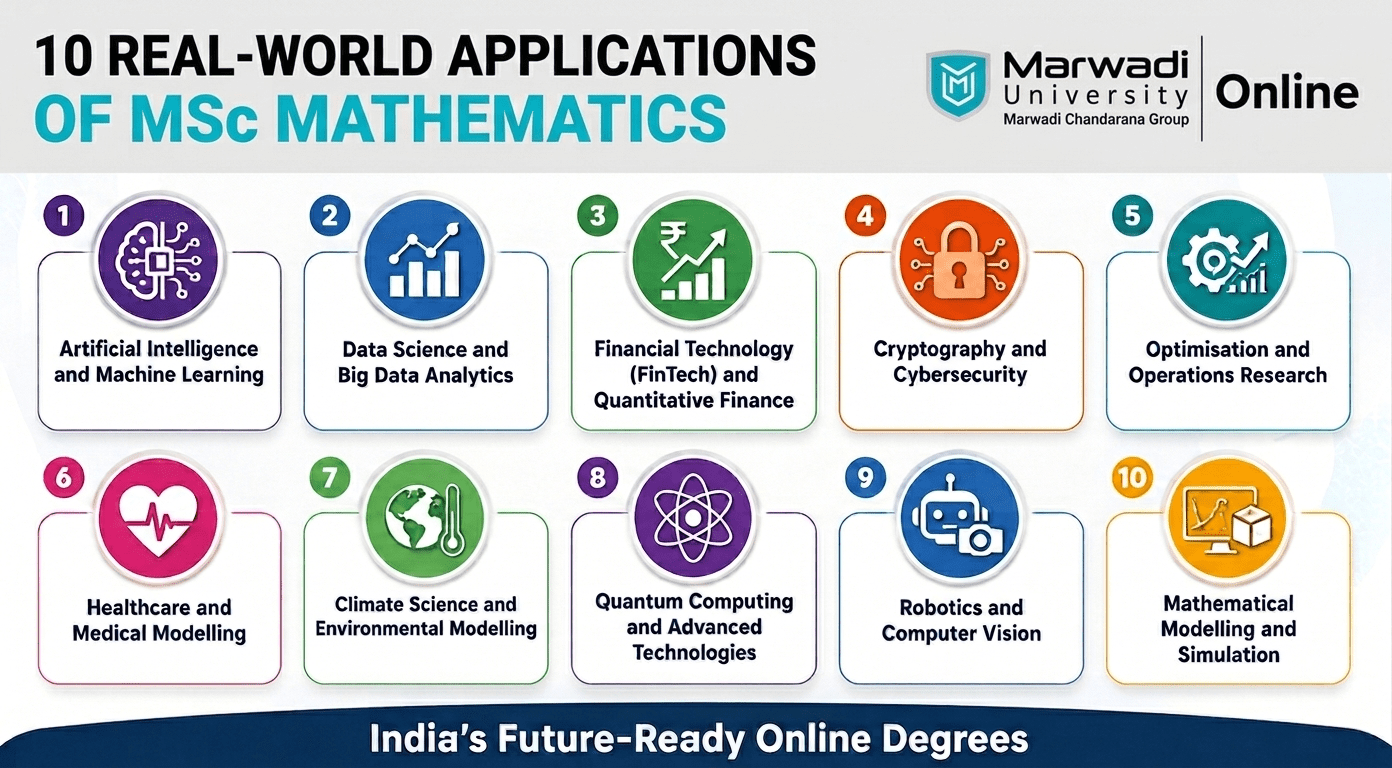
10 Real-World Applications of MSc Mathematics
1. Artificial Intelligence and Machine Learning
Artificial intelligence relies on mathematics to help machines learn patterns, make predictions, and improve decisions. Linear algebra, probability, statistics, calculus, and optimisation are important foundations behind many AI systems.
For students interested in MSc Mathematics and AI, this is one of the most promising application areas. Mathematical models help train machine-learning algorithms, measure uncertainty, process data, and improve model performance.
Key applications include:
- Predictive modelling
- Neural networks
- Computer vision
- Natural language processing
- Recommendation systems
Students can combine mathematics with Python and machine learning to explore technology-focused roles. This can create pathways towards MSc Mathematics jobs in AI and data science across technology, finance, healthcare, and research organisations.
2. Data Science and Big Data
Data science converts large amounts of information into useful insights, and mathematics provides much of the foundation behind this process. Statistics, probability, regression, optimisation, and mathematical modelling help professionals identify patterns and make reliable predictions.
MSc Mathematics in data science can prepare students for analytical roles involving data interpretation, predictive modelling, and decision-making.
Common applications include:
- Customer behaviour analysis
- Demand forecasting
- Risk prediction
- Business intelligence
- Predictive analytics
Students can strengthen their profile by learning Python, SQL, statistics, machine learning, and data visualisation. These complementary skills can help mathematics graduates work across technology, banking, healthcare, retail, consulting, and other data-driven industries.
3. Financial Technology and Quantitative Finance
Modern finance uses mathematics to understand risk, pricing, investment strategies, and market behaviour. Probability, statistics, calculus, differential equations, and optimisation can support financial modelling and decision-making.
This makes quantitative finance an important area among MSc Mathematics applications.
Real-world uses include:
- Risk assessment
- Algorithmic trading
- Portfolio optimisation
- Credit scoring
- Financial forecasting
Students interested in analytical careers can explore roles such as quantitative analyst, risk analyst, financial modeller, and data analyst. Combining an MSc Mathematics qualification with programming and financial knowledge can improve employability in banks, fintech companies, investment firms, and financial technology teams.
4. Cryptography and Cybersecurity
Every secure online transaction depends on mathematics in some form. Cryptography uses mathematical concepts to protect information, verify identities, and secure digital communication.
Number theory, algebra, probability, and discrete mathematics are particularly relevant to cryptographic systems. This creates an interesting connection between mathematics and cybersecurity.
Applications include:
- Encryption and decryption
- Digital signatures
- Secure authentication
- Blockchain security
- Data protection
Students who enjoy logical problem-solving can consider cybersecurity among their MSc Mathematics career options. Learning programming, computer networks, cryptography, and security concepts can help graduates develop specialised skills for technology roles.
This application also shows how mathematical thinking can contribute to protecting digital systems and information in an increasingly connected world.
5. Optimisation and Operations Research
Businesses constantly need to make better decisions with limited time, money, people, and resources. Mathematics helps solve these challenges through optimisation and operations research.
Linear programming, probability, statistics, graph theory, and mathematical modelling can identify efficient solutions for logistics, manufacturing, transportation, and supply chains.
Examples include:
- Delivery route optimisation
- Inventory planning
- Workforce scheduling
- Production planning
- Supply-chain management
This field demonstrates how mathematical thinking can solve practical business problems. Graduates can explore roles in operations research, business analytics, supply-chain analytics, and optimisation.
It is also connected to the broader Mathematics applications in emerging technologies, where algorithms increasingly support automated and data-driven decision-making across industries.
6. Healthcare and Medical Modelling
Mathematics plays an important role in healthcare by helping researchers understand diseases, analyse medical data, and predict outcomes. Mathematical and statistical models can represent disease patterns, health risks, treatment outcomes, and population trends.
Applications include:
- Disease modelling
- Medical statistics
- Epidemiology
- Medical imaging
- Treatment optimisation
As healthcare becomes increasingly digital, professionals who understand mathematics and data can contribute to analytics, modelling, and research projects.
Students can combine mathematics with statistics, programming, bioinformatics, or healthcare analytics to develop specialised skills.
This application shows that MSc Mathematics career opportunities are not limited to technology companies. Mathematical expertise can also contribute to pharmaceutical organisations, hospitals, research institutions, healthcare companies, and public-health projects.
7. Climate Science and Environmental Modelling
Understanding climate and environmental systems requires analysing complex data and relationships. Mathematics helps researchers build models that represent weather patterns, climate trends, natural systems, and environmental risks.
Calculus, differential equations, statistics, probability, and numerical methods can contribute to environmental modelling.
Real-world applications include:
- Climate forecasting
- Weather prediction
- Pollution modelling
- Water-resource planning
- Disaster-risk analysis
As organisations focus more on sustainability and climate resilience, data-driven environmental analysis is becoming increasingly important.
Mathematics graduates can develop relevant expertise through programming, computational modelling, statistics, and environmental science. This is one example of how the MSc Mathematics future scope can extend into interdisciplinary careers connecting mathematics, technology, science, and sustainability.
8. Quantum Computing and Advanced Technologies
Quantum computing is an emerging technology where mathematics plays a central role. Linear algebra, probability, complex numbers, and advanced mathematical concepts help describe quantum systems and develop quantum algorithms.
This makes quantum computing an important area within Mathematics applications in emerging technologies.
Potential applications include:
- Quantum algorithms
- Cryptography
- Molecular simulation
- Optimisation
- Scientific computing
Students interested in this field can strengthen their knowledge of linear algebra, programming, quantum concepts, and computational mathematics.
Although quantum computing is still developing, its potential makes it an exciting direction for future research and technology. Mathematics graduates may find opportunities in advanced computing, research, algorithm development, simulation, and specialised analytical roles.
9. Robotics and Computer Vision
Robots need mathematics to understand movement, position, distance, images, and their surrounding environment. Geometry, linear algebra, calculus, probability, and optimisation support many robotics and computer-vision systems.
Applications include:
- Robot navigation
- Image recognition
- Motion planning
- Autonomous vehicles
- Industrial automation
Students can combine mathematical knowledge with programming, machine learning, computer vision, and numerical methods to connect theory with practical technology projects.
For students researching MSc Mathematics jobs in 2026, robotics and automation are worth watching as industries increasingly adopt intelligent machines across manufacturing, logistics, healthcare, and other sectors.
This field demonstrates how mathematical reasoning can contribute to machines that perceive, analyse, and respond to real-world situations.
10. Mathematical Modelling and Simulation
Mathematical modelling converts real-world problems into mathematical representations that can be analysed, tested, and simulated. It is one of the most versatile MSc Mathematics applications because modelling is useful across science, engineering, business, economics, and technology.
Applications include:
- Population modelling
- Financial simulations
- Engineering analysis
- Traffic modelling
- Business forecasting
Mathematical modellers use equations, statistics, computational methods, and simulations to understand possible outcomes before decisions are made.
Students can build this pathway through programming, numerical analysis, statistics, and domain knowledge.
As organisations increasingly rely on simulations and predictive systems, modelling remains relevant to the future of mathematics in technology. It can create opportunities in research, analytics, consulting, engineering support, and technology development.
Final Thoughts
The real value of an MSc in Mathematics lies in how mathematical thinking can be applied beyond traditional academic settings. From AI and data science to cybersecurity, finance, healthcare, climate science, robotics, and quantum computing, mathematics supports many technologies and decisions shaping modern life.
The MSc Mathematics career scope is therefore becoming broader and more interdisciplinary. However, a postgraduate mathematics degree is only one part of career preparation. Students can increase their opportunities by developing complementary skills such as programming, data analysis, machine learning, statistical software, mathematical modelling, and communication.
The right combination of mathematical fundamentals and technology skills can help graduates explore diverse MSc Mathematics career opportunities. Depending on their interests, they may move towards analytics, research, finance, AI, cybersecurity, operations, modelling, or emerging technologies.
The MSc Mathematics future scope will continue to evolve as industries adopt automation, intelligent systems, advanced computing, and data-driven decision-making. For students willing to keep learning and apply mathematics to new challenges, an MSc can provide a strong foundation for future-ready careers.
FAQs
1. What is the career scope after MSc Mathematics?
It includes careers in data science, AI, finance, research, analytics, cybersecurity, education, operations research, and mathematical modelling.
2. Can MSc Mathematics graduates work in AI?
Yes. Mathematics supports AI through linear algebra, probability, statistics, calculus, and optimisation.
3. Is MSc Mathematics useful for data science?
Yes. Mathematical and statistical skills help professionals analyse data, build models, measure uncertainty, and develop predictive solutions.
4. What are the emerging applications of mathematics?
Emerging applications include AI, quantum computing, cybersecurity, robotics, fintech, healthcare analytics, advanced simulation, and climate modelling.
5. What skills should MSc Mathematics students learn for future careers?
Students can learn Python, SQL, statistics, machine learning, data visualisation, mathematical modelling, optimisation, and communication skills.