
Online MSc Mathematics: Is It a Smart Career Choice in 2026?
Mathematics is no longer limited to classrooms, textbooks, or traditional teaching careers. In 2026, mathematical thinking is increasingly valuable in areas such as data analytics, finance, actuarial science, research, technology, and artificial intelligence.
This makes an online MSc Mathematics an interesting option for students and working professionals who want to build advanced mathematical knowledge without leaving their current commitments.
But is pursuing an online MSc Mathematics really a smart career choice in 2026? The answer depends on your career goals, skills, and how you use the degree.
An MSc in Mathematics can strengthen your logical reasoning, analytical thinking, problem-solving, and quantitative skills. These abilities can be useful across several industries, especially as businesses become more dependent on data and technology.
For students exploring an online MSc Mathematics in India, flexibility is another major advantage. You can study remotely while managing work, preparation for competitive examinations, or other responsibilities.
This guide explains the course, skills you can develop, career options, salary trends, and why an online programme can be worth considering in 2026.
What is Online MSc Mathematics?
An online MSc Mathematics is a postgraduate degree that provides advanced knowledge of mathematical theories, concepts, methods, and applications through online learning.
Typically completed over two years, the programme can be suitable for graduates who want to deepen their understanding of mathematics while enjoying greater flexibility.
The curriculum generally covers areas such as:
- Advanced calculus and linear algebra
- Abstract algebra and number theory
- Complex analysis and topology
- Mathematical statistics
- Numerical analysis
- Differential equations
- Mathematical modelling
- Financial mathematics
- Optimization techniques
- Research-oriented mathematics
At Marwadi University Online, the two-year programme is delivered 100% online across four semesters.
Its curriculum includes subjects such as:
- Complex Analysis
- Optimization Techniques
- Topology
- Abstract Algebra
- Numerical Analysis with MATLAB Programming
- Financial Mathematics
- Mathematical Statistics
- Mathematical Modelling and Simulation
For students considering online MSc Mathematics in India, this mode of learning can make postgraduate education more accessible without requiring relocation or daily campus attendance.
What Skills Will You Learn?
An MSc Mathematics programme can help you develop skills that go beyond solving equations. These skills can be useful in both academic and industry-oriented careers.
Key skills include:
- Analytical and logical reasoning
- Advanced problem-solving
- Mathematical modelling
- Statistical thinking
- Quantitative analysis
- Research and interpretation
- Computational skills
- Data-driven decision-making
- Structured and critical thinking
Learning tools such as MATLAB can also help students connect mathematical concepts with computational applications. Marwadi University Online’s curriculum includes Numerical Analysis with MATLAB Programming and Image Processing, and Fuzzy Logic using MATLAB.
These skills can provide a foundation for careers involving data, finance, research, education, and technology.
What Is the Career Scope of Online MSc Mathematics?
The online MSc Mathematics career scope is broader than traditional teaching and academic roles. Mathematics graduates can explore opportunities wherever strong quantitative, analytical, and problem-solving abilities are valued.
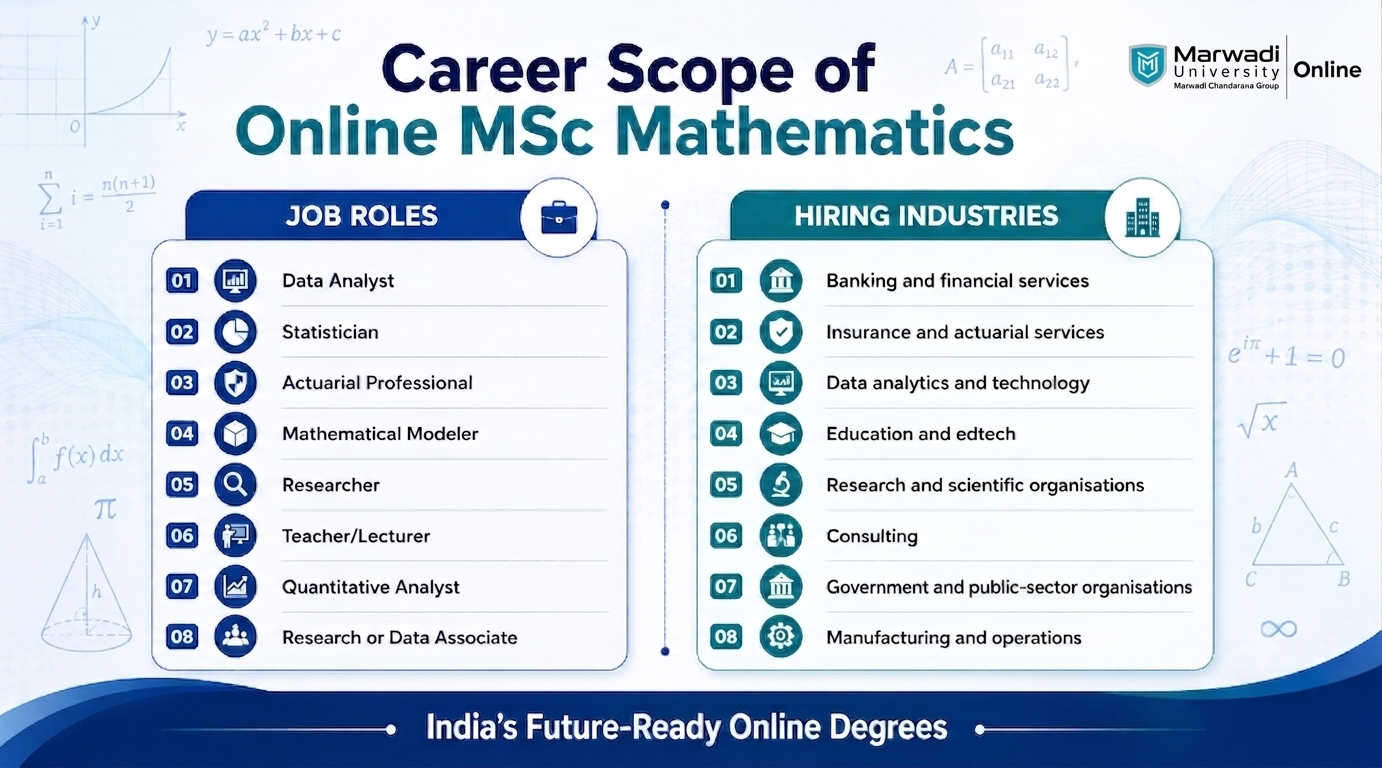
Popular career paths include:
- Data Analyst: Analyse data and identify useful business insights.
- Statistician: Apply statistical methods to research and business problems.
- Actuarial Professional: Use mathematics and statistics to assess financial risk.
- Mathematical Modeler: Build mathematical models for real-world problems.
- Researcher: Work in mathematical, scientific, or interdisciplinary research.
- Teacher/Lecturer: Build a career in mathematics education, subject to applicable qualifications.
- Quantitative Analyst: Apply mathematics and statistics to financial and investment problems.
- Research or Data Associate: Support analytical and research projects.
The MSc Mathematics career opportunities extend across industries such as:
- Banking and financial services
- Insurance and actuarial services
- Data analytics and technology
- Education and edtech
- Research and scientific organisations
- Consulting
- Government and public-sector organisations
- Manufacturing and operations
The MSc Mathematics career in AI and data science is also gaining attention because mathematical foundations support statistics, modelling, optimization, probability, and quantitative analysis. However, students targeting these fields should complement their mathematics degree with skills such as Python, statistics, machine learning, SQL, or data visualization.
So, what can I do after MSc Mathematics? You can choose between academic pathways, teaching, research, analytics, finance, actuarial science, mathematical modelling, or further specialization depending on your interests and additional skills.
What Are the Salary Trends?
Salary after an MSc Mathematics varies significantly according to job role, technical skills, experience, location, and industry.
As a practical 2026 benchmark, fresh graduates may commonly see opportunities around ₹3–6 LPA, while professionals with relevant experience and strong technical skills can move towards ₹8–20 LPA or more in areas such as analytics, data science, actuarial science, and quantitative roles.
- Entry-level roles: ₹3-6 LPA
- Mid-level professionals: ₹6-12 LPA
- Experienced specialists: ₹12-20 LPA+
Building practical skills, gaining experience, and choosing a high-demand specialization can significantly influence your earning potential.
Why Study Online MSc Mathematics from Marwadi University Online?
Choosing the right university matters as much as choosing the right degree. Marwadi University Online offers a flexible online MSc Mathematics programme designed for graduates who want advanced mathematical knowledge without following a traditional classroom schedule.
Marwadi University Online holds NAAC A+ accreditation, has NBA Tier-1 programs, holds a 353 QS Asia rank, a Top 110-125 NIRF rank, and is awarded as a Centre of Excellence by the Government of Gujarat.
Here are some key reasons to consider the programme:
- 100% online learning: Study from anywhere while managing other commitments.
- Two-year programme: Complete the degree across four semesters.
- UGC-recognised degree: The programme is listed as a UGC-recognised online MSc Mathematics degree.
- Relevant curriculum: Subjects include mathematical statistics, financial mathematics, mathematical modelling, optimization, numerical analysis, and more.
- Computational exposure: The curriculum includes MATLAB-based numerical analysis and image processing/fuzzy logic.
- Academic progression: The programme can support students interested in UGC-NET, SET, PhD entrance examinations, research, and academic careers.
- Flexible assessment: Students complete assignments and online examinations.
The online MSc Mathematics fees for Indian students are ₹15,000 per semester, with a one-time programme fee option of ₹49,000.
For online MSc Mathematics eligibility, Indian applicants should have a graduate degree with Mathematics as a compulsory subject and 50% or above marks or an equivalent grade in aggregate.
Final Thoughts
So, is online MSc Mathematics worth it in 2026? For students who genuinely enjoy mathematics and want to build careers around analytical thinking, research, education, finance, data, or quantitative problem-solving, it can be a valuable postgraduate option.
The key is to look beyond the degree itself. Mathematics provides a strong foundation, but combining that foundation with practical and digital skills can make your profile more relevant to today’s job market.
If you are interested in data-oriented careers, consider developing Python, SQL, statistics, machine learning, or data visualization skills alongside your mathematics education. If teaching or research interests you, focus on subject expertise, academic qualifications, research projects, and competitive examinations.
An online MSc Mathematics can also be useful for learners who need flexibility. Studying online allows you to pursue postgraduate education while managing work, preparation, or personal responsibilities.
Ultimately, the value of the degree depends on what you do with it. Choose a programme with a relevant curriculum, recognised credentials, flexible learning, and opportunities to build practical knowledge.
For students looking for an online MSc Mathematics in India, Marwadi University Online offers a structured two-year programme covering advanced mathematics, statistics, modelling, financial mathematics, computational methods, and research-oriented subjects.
If mathematics is your strength and you are ready to combine it with modern skills, 2026 could be a good time to turn it into a career advantage.
FAQs
1. Is an online MSc Mathematics worth it in 2026?
Yes, it can be valuable for students interested in mathematics, analytics, finance, research, teaching, and quantitative careers. Your outcomes will depend on your skills, experience, and career direction.
2. What are the career options after an online MSc Mathematics?
Graduates can explore roles such as data analyst, statistician, actuarial professional, mathematical modeller, researcher, teacher, and quantitative analyst.
3. What is the eligibility for an online MSc Mathematics?
Eligibility varies by university. Marwadi University Online requires Indian applicants to have a graduate degree with Mathematics as a compulsory subject and at least 50% marks or an equivalent grade.
4. What is the salary after MSc Mathematics in India?
Entry-level salaries typically range from ₹3-6 LPA, while experienced professionals with relevant skills may earn ₹8-20 LPA or more, depending on the role and industry.
5. Can MSc Mathematics graduates work in AI and data science?
Yes. Mathematics provides useful foundations in statistics, modelling, optimization, and quantitative analysis. Additional skills in Python, machine learning, SQL, and data analytics can improve career readiness.