
Online MBA in Logistics and Supply Chain Management in 2026: Syllabus, Career Scope & Salary
The way businesses move products, manage inventory, and deliver orders is changing rapidly. From e-commerce and global trade to manufacturing and retail, every industry depends on efficient logistics and supply chain operations. This has increased the demand for professionals who understand both business management and modern supply chain systems. An online MBA in logistics and supply chain management can help students and working professionals build these skills while studying flexibly.
The online MBA in logistics and supply chain management 2026 is especially relevant for learners who want to understand procurement, warehousing, transportation, inventory, operations, and digital supply chain management. As businesses adopt artificial intelligence, automation, data analytics, and smart logistics platforms, skilled professionals are becoming increasingly valuable.
This blog explains the online MBA logistics and supply chain management syllabus, career scope, salary trends, skills, job opportunities, and future prospects. It also discusses why an online programme can be a practical choice for students and working professionals looking to advance their careers in this growing field.
Whether you are planning your first postgraduate degree or looking to move into logistics and operations management, this guide will help you understand what to expect from this career-focused programme.
What Is an Online MBA in Logistics and Supply Chain Management?
An online MBA in logistics and supply chain management is a 2-year postgraduate management programme that combines core business education with specialised knowledge of logistics, supply chains, operations, procurement, and distribution. Students learn how products, information, and resources move from suppliers to customers.
Unlike a traditional full-time programme, an online MBA offers flexibility. Students can access learning materials, attend online classes, and complete academic activities remotely. This
makes it suitable for working professionals, entrepreneurs, and learners who need to balance education with other responsibilities.
The programme generally covers areas such as:
- Sourcing Management
- Total Quality Management
- Physical Distribution And Transportation Management
- Material Management And Inventory Control
- Fundamentals of Logistics and Supply Chain Management
- Sourcing Management
- Enterprise Resource Planning and Business Process Management
- Shipping and Maritime Logistics Management
- Packing and Packaging Management
- International Logistics Management
The online MBA in supply chain management in India is becoming increasingly relevant as businesses expand across regions and depend on efficient delivery networks. Students gain a broader understanding of business operations while developing specialised knowledge for the logistics sector. The programme can also help learners prepare for management-level responsibilities in a rapidly evolving industry.
Future Scope with AI and Technology
Technology is rapidly transforming logistics and supply chain management. Artificial intelligence, automation, cloud computing, the Internet of Things (IoT), robotics, and data analytics are helping businesses make faster, smarter, and more accurate decisions. As companies manage increasingly complex supply networks, technology-driven skills are becoming essential for professionals in this field.
AI and digital technologies are being used for:
- Demand forecasting: Predicting customer demand and planning inventory more efficiently.
- Route optimisation: Finding faster and more cost-effective transportation routes.
- Inventory planning: Reducing excess stock and preventing product shortages.
- Warehouse automation: Using robotics and automated systems to improve storage and order fulfilment.
- Real-time tracking: Using IoT devices to monitor shipments, vehicles, and storage conditions.
- Data-driven decision-making: Identifying delays, controlling costs, and improving overall efficiency.
Because of these developments, the future of logistics and supply chain management careers is increasingly connected to technology and digital decision-making. Professionals are no longer expected to only manage transportation, warehouses, or procurement. They also need to understand data, digital platforms, automation, and technology-driven business strategies.
An online MBA in logistics and supply chain management 2026 can help students develop management knowledge relevant to this changing industry. Learners who combine supply chain expertise with technology, analytics, and problem-solving skills may find opportunities across industries such as e-commerce, manufacturing, retail, healthcare, and transportation.
The future is likely to favour professionals who can connect business strategy with digital supply chain solutions. Therefore, continuous learning, technology awareness, and adaptability will remain important for long-term career growth.
Skills You Will Learn
An MBA in logistics and supply chain management helps students develop a combination of business, technical, analytical, and leadership skills. These skills are useful across logistics, manufacturing, retail, e-commerce, consulting, and other industries.
Important skills developed through the programme may include:
- Supply chain planning
- Procurement and vendor management
- Inventory control
- Warehouse operations
- Transportation management
- Business analytics
- Cost management
- Strategic decision-making
- Problem-solving
- Leadership and communication
The online MBA logistics and supply chain management syllabus generally introduces students to both management fundamentals and specialised supply chain concepts. This helps learners understand how individual activities connect to the larger business ecosystem.
For example, a delay in procurement can affect production, inventory, delivery schedules, and customer satisfaction. Understanding these connections helps professionals make better operational decisions.
Students also develop a broader business perspective through subjects related to finance, marketing, human resources, and strategic management. This can be particularly valuable for professionals who want to move from operational roles into managerial positions.
As businesses increasingly use digital platforms and analytics, learning to interpret information and make data-driven decisions can further strengthen a student’s professional profile.
Top Job Opportunities and Industries
The growth of e-commerce, manufacturing, global trade, retail, and technology has created demand for professionals with logistics and supply chain expertise. After completing the programme, graduates may explore roles across different business functions.
Common job roles include:
- Supply Chain Manager
- Logistics Manager
- Procurement Manager
- Operations Manager
- Inventory Manager
- Warehouse Manager
- Transportation Manager
- Demand Planner
- Sourcing Specialist
- Supply Chain Analyst
These roles are available across several industries, including:
- E-commerce
- Manufacturing
- Retail
- Automotive
- Pharmaceuticals
- FMCG
- Transportation
- Aviation
- Warehousing
- Consulting
The career opportunities after online MBA in logistics and supply chain management can vary depending on a candidate’s experience, skills, location, and specialisation. Professionals with strong analytical, technology, and leadership skills may be better positioned for career advancement.
The demand for MBA logistics and supply chain management jobs is also influenced by the growth of digital commerce and increasingly complex global supply networks. With experience, professionals may progress from specialist and executive roles to senior management and strategic leadership positions.
Salary Trends
Salary after an MBA in logistics and supply chain management depends on several factors, including experience, job role, industry, location, organisation, and professional skills. Candidates with prior work experience may also have access to different opportunities compared to fresh graduates.
Entry-level professionals may begin their careers in roles such as logistics executive, supply chain analyst, procurement executive, or operations coordinator. With experience, they can move into managerial and strategic positions.
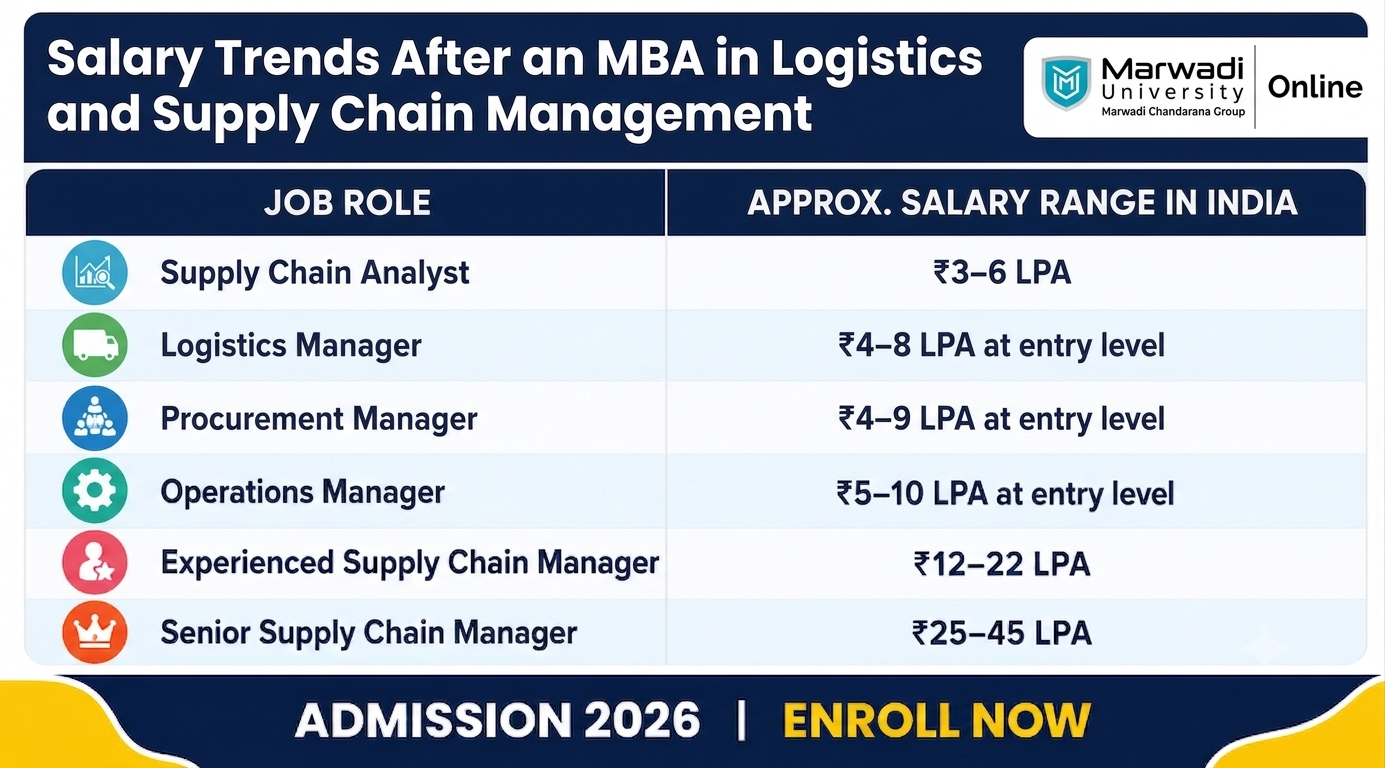
The online MBA logistics and supply chain management salary potential generally increases with:
- Relevant work experience
- Leadership responsibilities
- Technical and analytical skills
- Knowledge of digital supply chain tools
- Industry specialisation
- Professional certifications
Experienced professionals may pursue roles such as supply chain manager, procurement head, operations director, or logistics consultant. These positions generally involve greater responsibility and may offer higher compensation.
Students should also understand that an online MBA alone does not guarantee a specific salary. Career growth depends on how effectively learners apply their knowledge, develop practical skills, gain experience, and adapt to industry changes.
The programme can, however, provide a strong foundation for professionals aiming to move into management-oriented roles in logistics and supply chain operations.
Why Choose Marwadi University Online?
Choosing the right university is an important part of pursuing an online MBA. Students should consider the programme structure, learning experience, academic support, flexibility, curriculum relevance, and institutional credibility before making a decision.
Marwadi University Online offers learners the opportunity to pursue higher education through a flexible online format. This can be particularly useful for working professionals and students who want to continue their education without putting their careers or other responsibilities on hold.
The university is accredited with NAAC A+ grade, has NBA Tier-1 programs, 353 QS Asia rank, Top 110-125 NIRF rank, and is awarded as a Centre of Excellence by the Govt. of Gujarat.
A career-focused online MBA can help learners build knowledge in business management while developing an understanding of logistics and supply chain operations. Students can study at their own pace, access learning resources online, and build skills that are relevant to modern business environments.
The programme can be suitable for learners who want to:
- Develop management knowledge
- Understand supply chain operations
- Build business and leadership skills
- Continue working while studying
- Prepare for management-level career opportunities
Before applying, students should review the programme details, online MBA logistics management fees, admission requirements, and course structure. Understanding these details can help learners make a more informed decision about their education and career goals.
Final Thoughts
The logistics and supply chain industry is becoming more technology-driven, data-focused, and strategically important. Businesses across e-commerce, manufacturing, retail, healthcare, transportation, and other sectors need professionals who can manage complex operations and respond to changing customer expectations.
An online MBA in logistics and supply chain management can help learners build a strong foundation in business management, supply chain operations, procurement, logistics, analytics, and leadership. The online MBA logistics and supply chain management career scope can include opportunities in multiple industries and functional areas.
The programme may be especially valuable for professionals who want to move into management roles or upgrade their existing qualifications while continuing their careers. However, success depends on more than a degree. Developing practical knowledge, digital skills, analytical abilities, communication, and industry awareness can significantly strengthen career prospects.
As AI, automation, and data analytics continue to influence supply chains, professionals who combine management expertise with technology awareness may be better prepared for future opportunities.
If you are planning to build a career in this growing field, an online MBA in logistics and supply chain management can be a practical step towards developing the knowledge and skills required for the evolving world of modern business.
FAQs
1. What is an online MBA in logistics and supply chain management?
It is a postgraduate management programme that covers logistics, procurement, inventory, transportation, operations, supply chains, and business management through online learning.
2. What is the scope of an online MBA in logistics and supply chain management?
Graduates can explore roles in logistics, procurement, supply chain management, operations, warehousing, transportation, e-commerce, manufacturing, and retail.
3. What jobs can I get after an MBA in logistics and supply chain management?
Common roles include Supply Chain Manager, Logistics Manager, Procurement Manager, Operations Manager, Supply Chain Analyst, and Inventory Manager.
4. What is the salary after an online in logistics and supply chain management?
Salary depends on experience, job role, industry, location, skills, and organisation. Professionals with relevant experience and specialised skills may access better career opportunities.
5. Is an online MBA in logistics and supply chain management worth it?
Yes, it can be valuable for learners seeking flexible higher education and career opportunities in the growing logistics, operations, e-commerce, manufacturing, and supply chain sectors.