
Beyond Writing: Why an MA in English Matters in the Age of AI
Artificial intelligence is changing how we write, read, create, research, and communicate. Today, AI tools can draft articles, summarise books, translate languages, generate stories, and answer complex questions within seconds. This naturally raises an important question: Does an MA in English still matter when artificial intelligence can produce language so quickly?
The answer lies beyond writing.
An MA in English is not simply about learning how to write better. It develops critical thinking, interpretation, research, communication, creativity, cultural awareness, and the ability to understand how language shapes ideas and human experiences. These skills remain important even as technology becomes more capable.
The conversation around MA English in the AI era should therefore move beyond the fear of replacement. Instead, it should focus on how English graduates can work alongside AI and bring the human abilities that technology cannot fully replicate.
From literature and language to digital communication and AI-assisted work, the English degree in the age of AI is evolving. Its value increasingly comes from combining human insight with technological awareness.
The future is not necessarily about choosing between English and AI. It may be about understanding how both can work together.
When AI Can Write, What Is Left for Humans?
AI can generate grammatically correct content, but writing is more than putting words together. Human communication involves purpose, context, emotion, culture, and judgement.
This is where AI and English literature can intersect in interesting ways. Literature teaches us to look beyond the surface, interpret different perspectives, and understand complex human experiences.
In the humanities in the AI era, these abilities remain valuable because people still need to decide what should be communicated, why it matters, and how it should affect an audience.
AI can generate language. Humans give that language meaning.
What Can an English Graduate Bring to an AI-Driven World?
An English graduate can bring skills that complement technology rather than compete with it. Strong reading, interpretation, research, communication, and analytical abilities can help professionals work effectively with AI-generated information.
For English graduates in the AI era, the opportunity lies in developing a hybrid skill set. Understanding AI tools while retaining strong human judgement can create new possibilities across communication, research, media, education, publishing, and business.
The importance of an MA in English is therefore increasingly connected to what students can do with their knowledge in a technology-driven environment.
The Human Skills AI Can’t Fully Automate
Technology can automate many language-based tasks, but several human abilities remain central to meaningful communication. An MA English in the AI era can strengthen these capabilities through advanced reading, research, analysis, and interpretation.
- Critical Thinking: AI can provide an answer, but humans need to question whether the answer is accurate, relevant, biased, or useful. Critical thinking helps English graduates analyse arguments, identify assumptions, compare perspectives, and make informed decisions.
- Contextual Understanding: Words do not exist in isolation. Their meaning can change according to culture, audience, situation, history, and intention. An English degree in the age of AI can help students understand these layers and communicate appropriately across different contexts.
- Creativity: AI can generate variations of existing patterns, but human creativity is closely connected to personal experience, imagination, observation, and intention. English education encourages students to experiment with ideas, narratives, language, and different forms of expression.
- Emotional Intelligence: Effective communication requires more than correct grammar. It requires understanding how people feel and how words may be received. English graduates can use empathy and emotional awareness to create communication that feels relevant, respectful, and human.
- Ethical Reasoning: AI-generated content raises questions about originality, bias, authorship, misinformation, and responsibility. The future of MA English can therefore include developing the judgement needed to use AI thoughtfully rather than accepting every generated response without question.
How AI Is Creating a New Role for English Professionals
The relationship between English and artificial intelligence is not simply about replacing writers with machines. AI is changing workflows and creating new responsibilities around language, communication, quality, and human oversight.
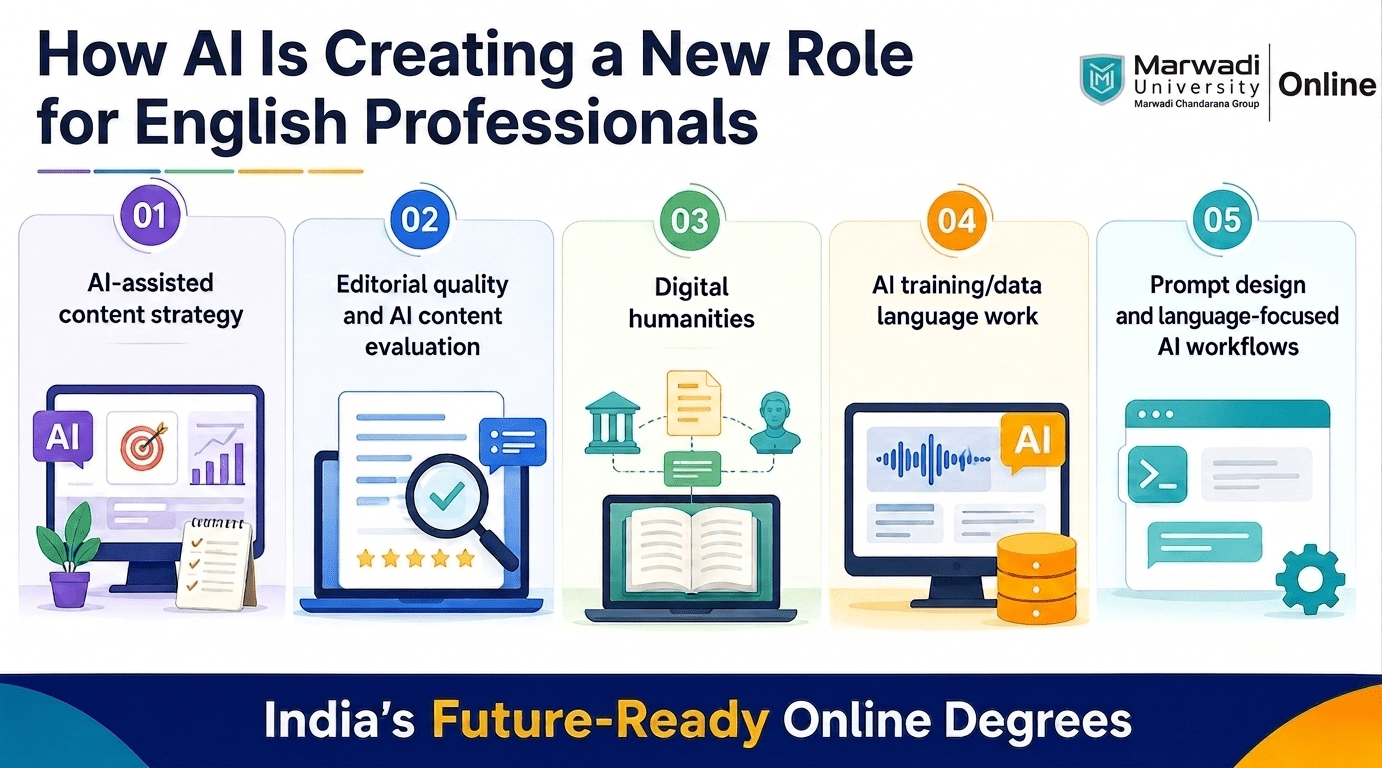
English professionals can explore roles and skills across areas such as:
- AI-assisted content strategy: AI can support research, ideation, and content planning, while English professionals provide strategy, audience understanding, tone, and editorial direction.
- Editorial quality and AI content evaluation: As AI-generated content increases, professionals are needed to review accuracy, clarity, originality, tone, context, and overall quality.
- Digital humanities: Technology is opening new ways to study literature, language, culture, archives, and texts through digital tools and data.
- AI training and data language work: Language professionals can contribute to tasks involving linguistic data, text quality, annotation, evaluation, and language-focused AI systems.
- Prompt design and language-focused AI workflows: Understanding how language works can help professionals create clearer prompts, evaluate AI responses, and develop efficient AI-supported workflows.
These possibilities highlight the changing future of English graduates. The strongest opportunities may increasingly belong to professionals who combine language expertise with digital and AI literacy.
Rather than asking whether AI will eliminate English-related careers, students can ask a more useful question: How can English expertise become more valuable when AI is everywhere?
Final Thoughts
The future of MA English is not about protecting English from technology. It is about allowing the discipline to evolve with it.
AI can generate text quickly, but humans still need to interpret ideas, understand context, evaluate information, create meaning, communicate with empathy, and make ethical decisions. That is why the importance of an MA in English can extend far beyond traditional writing.
For students considering an MA in English, the opportunity is to combine the strengths of language and literature with AI awareness and digital skills.
The future belongs neither entirely to humans nor machines. It belongs to people who know how to use technology without losing the human thinking behind communication.
FAQs
1. Is an MA in English still relevant in the age of AI?
Yes. An MA in English develops critical thinking, communication, research, interpretation, creativity, and contextual understanding, skills that remain valuable alongside AI.
2. Will AI replace English graduates?
AI may automate some language-based tasks, but it is more likely to change English-related roles than completely replace English graduates in the AI era.
3. What skills can an MA in English develop for the AI era?
An MA in English can develop critical thinking, research, communication, creativity, interpretation, cultural awareness, and analytical skills that complement AI literacy.
4. How is AI changing English education?
AI and English education are increasingly connected through AI-assisted research, digital humanities, content evaluation, language technologies, and new approaches to teaching and learning.
5. What is the future of an MA in English?
The future of MA English lies in combining language and humanities expertise with AI literacy, digital communication, critical thinking, research, and interdisciplinary skills.